Sunday, May 29, 2011
Seeing

Thursday, May 19, 2011
In the Beginning

What we could do is think about not
what the story says to us, but what it might
have meant to its first hearers.
Genesis 1:27 makes clear the equality of men and women as imaged after God’s own self. What then are we to do with the second creation account, the one where Eve comes from a rib, lives as a helpmate, falls for the forbidden fruit, and ultimately gets kicked out – with Adam, it must be admitted – of the garden?
What we could do is think about not what the story says to us, but what it might have meant to its first hearers. And why. Because this second account is not a happy story. It includes wrong decisions, deception, secrecy, shame, and ultimately, punishment. And the story has long been used as instructive. But cultural deconstruction – a critical literary process that requires the reader to reverse her cultural expectations – reveals a few interesting ideas:
1) Adam and Eve live as nomads, freely partaking in the riches of God’s garden. When they leave God’s garden, they are cursed with the responsibility of making their own garden, of becoming agrarian, a cultural system that requires specialization of tasks, a system rife with all kinds of inequality.
2) The curse is echoed in the murder of Abel, a shepherd, by his brother, Cain, a farmer. Cain is physically marked with his curse. And he builds a city, further covering over (exploiting?) God’s garden with his own constructions.
3) The people who passed down this creation account, generation after generation, were a nomadic people. They had sheep. And goats. They traveled (except for when they were slaves). Continued conflict with their agrarian, sometimes urban, neighbors led them to build cities of their own, to request a king, to collect wealth. To stop living as nomads.
What, then, if this creation account – the one that seems to cause us so many problems around sin, around male-female relationships, around identity – were a story of what went wrong with “those” people rather than a story of how “we” were created? What if this account is an explanation early Israelites gave to their children in order to make sense of their crazy, sinful, and out-of-balance-with-God’s-world neighbors?
Tuesday, May 17, 2011
Discovery

When God intervenes in human affairs, what is the nature of that intervention? For instance, I believe God can and often does correct our misunderstandings. But I mean that as directional, not terminal. I think -- and I'm just trying this out here -- that God's corrections are like soft side barriers that keep us from veering too far off course. I don't think God's corrections leave us with a definitive understanding of the nature of God. God gets us back on track without ending our journey of discovery.
Thursday, May 12, 2011
Eighth Day

The story of Christ is a creation account, an account in which Jesus' resurrection serves as the eighth day of creation, a new beginning for an old world. It's a story in which our response to Jesus' invitation plays a part in what the world becomes. To those who say it is finished, I argue it's just begun. After all, there's lots of work yet to be done and plenty that needs undone as well.
Thursday, May 05, 2011
Anti-World

I'm convinced that most streams of Christianity come across as anti-world, no matter what their claimed intentions. Conservatives want to take over the world, so they can fix it. Liberals strive for relevance to the needs of the world, so they can transform it. Many of the rest of us simply avoid the world, defining ourselves by what we're against.
But what if we joined with the world rather than criticizing or fighting? What if we learned to see God reflected by and active in? What if we learned to love?
Monday, May 02, 2011
Egalitarian?

On Feminist Theology
What if the story we’ve believed – about
hierarchy, about power, about apostolic succession
- is really just a story of what we’ve become
If it’s not true, then the Church is a tool of oppression.
If it’s true, then the Church as organic, egalitarian community has succumbed to a masculine culture.
That’s what’s called a lose-lose proposition. And the only way to deal with it is straight on. We have to face what we really are. We have to deal with the mess we’ve made. We have to admit that doing so will take both time and work. Hard work. And a lot of time.
We start by re-imagining what it means to be the Church, and starting with an inversion of gender shows us one possible beginning. What if “womankind” stood for all humanity? What if “Jesus came to save all women”? What if we only spoke of the “motherhood of God”?
When we laugh aloud (or privately scoff) at such a suggestion, we reveal the truth of the argument. Whatever it is that makes us uncomfortable deserves further inspection.
I'm not arguing for the feminization of theology or of the Church. Instead, I'm arguing for freedom and for a freedom that extends to all. My hope is that the Church might become truly counter-cultural, truly transformational, truly revolutionary, that the Church might become Christ’s body, offering saving grace and liberation to a culture in chains.
At Barclay Press
Tuesday, April 26, 2011
The Other

A friend -- during a recent visit to South Africa -- had a discussion about Apartheid with a man born in 1977. This man had lived in both the old and new South Africa and had reason -- my friend believed -- to have a unique insight from the inside. But this man was puzzled by her interest. He admitted that he hadn't really noticed Apartheid until it was officially repealed. Life had seemed normal to him. The separation and subjugation of indigenous peoples had been completely invisible.
I wonder how much of our own treatment (and mistreatment) of others is similarly invisible. I wonder how our progressive but infrequent stands "for the other and marginalized" look to those who are genuinely "other and marginalized." And I wonder if it's possible for those of us on the inside to work for change.
Sunday, April 24, 2011
Choosing
Thursday, April 21, 2011
Reading
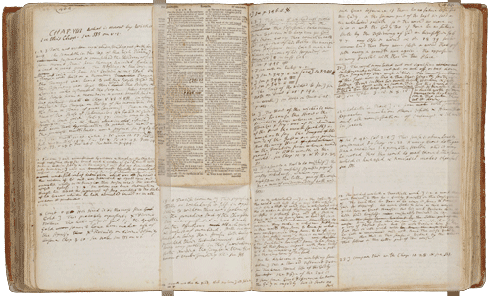
We do a disservice to the faithful (and to the scriptures) when we insist that they read in a certain way and from a certain perspective. It's fun to explore, to imagine, to re-think, to challenge. It's creative. What if we could learn to encounter both God and scripture in the way we often encounter those closest to us -- with a sense of play?
Friday, April 15, 2011
Poverty

How do we overcome the American belief in unlimited resources and unlimited opportunity – a belief that makes us less likely to share with the needy, more likely to see their poverty as the result of poor choices?